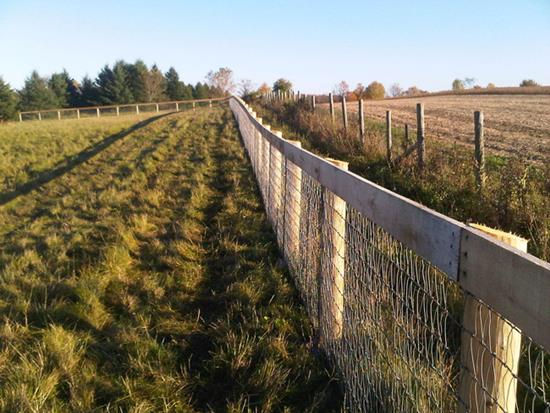
Diamond Mesh agricultural fence
Agricultural fencing comes in a variety of forms. It is designed for easy installation and maintenance. It is also economical so that it can be used around very large fields. Choosing the right type of agricultural fencing involves balancing the features of the fencing with the cost. Property owners must also consider what livestock or wild animals will need to be controlled by the fencing. A handful of agricultural fencing options have become very popular over the last few decades.
Smooth Wire Fencing
Smooth wire fencing is a very common choice for a variety of different applications. This type of fencing is made from straight wires that are stretched with high tension between posts. The wire is inexpensive, lasts for a long time and is easy to repair and maintain. It is useful for marking property boundaries. It is also effective when used to contain larger docile animals like cattle. Smooth wire fencing is not good for keeping wildlife and predators out of a field although they are appropriate for properties where animals are allowed to pass through the fence. The smooth metal will not harm animals moving between the wires.
Barbed Wire Fencing
Barbed wire fencing is a variation on smooth wire fencing. Barbed wire has small metal spikes spaced evenly along the line. Barbed wire is frequently used to contain cattle and sheep. Large animals that brush against the wire will naturally recoil and will not pass through the area. Animals like goats and deer that can jump will be able to cross the fence. This type of fencing is not recommended for use around horses because coming into light contact with the barbs could cause cuts and injuries that can become infected.
Field Fencing
Field fencing or woven fencing is different from the wire options. This type of fencing is made from horizontal and vertical metal wires that are woven, knotted or welded together. The result is a grid-like fence that is often sold in rolls or panels. The fencing requires more beams than wire options. This fencing can effectively hold goats, pigs and sheep. It is also effective at stopping most predators like wolves from entering a field. The size of the square openings between the wires on the fence has to be examined carefully if the fencing will be used to hold livestock. Overly large openings could allow an animal like a horse to become tangled in the fencing causing injuries. This is a very effective way to stop deer when the fencing is stacked high enough. Although woven fencing is very effective, it also tends to be more expensive than simple wire fences.
Electrical Fencing
Checking Electric Fence for a Current: A Gove County, Kansas farmer uses a tool to check that the smooth-wire electric fence (braided here with a barbed wire) is carrying a current. The wire delivers a mild shock to cattle that touch it, training them to stay away. Photo Courtesy: Chris Hartman
One option that many farmers and ranchers choose is the addition of electrical agricultural fencing. There are electrical systems available that will work with existing wires and others that require a special wire to be stretched between posts. The addition of electrical fencing helps to deal with livestock like sheep, cattle and horses. It also works to stop many predators and nuisance animals from entering the property. The drawback is that the fence draws power while in operation.
This post was written by Ken Aston, a farmer who used http://www.totalequinefencing.com/ for his fence.
Filed under Farm Fencing by . 1 Comment. ![]()
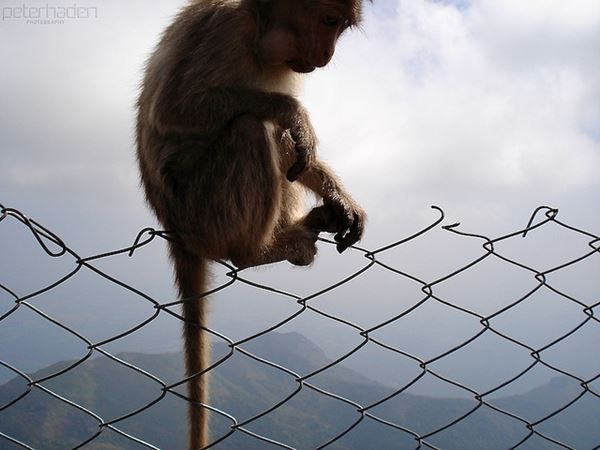
A monkey considers his next move on a fence in Kodaikanal, India. Photo Courtesy: Peter Haden
Ecological protection is necessarily one of the top requirements for individuals, companies and industries today.
New products can mollify potential hazards to and from protected wildlife species, such as water voles, badgers and otters. This means that if any protected species are affecting areas of your land, or business, specialist fencing can be installed to ensure the protection of your property and, at the same time the ecological control of the wildlife.
All materials used are recyclable and sustainable and delivery and completion are carried out in the most environmentally sensitive way. In this way, the needs of clients are met without a damaging impact on either fauna, or flora. Given the growing concern about the decline of much of our iconic wildlife, this is clearly a necessity that will become even more important in the future.
Badgers:
One particular service, which has gained considerable acclaim, is the creation of badger setts, to protect these unique creatures. Each sett is designed appropriate to the needs and surroundings of the immediate area and in close consultation with an ecological consultant.
The majority of cases, local, environmentally friendly materials are used and setts are reinforced to prevent damage and disturbance. Each entrance to the sett is also individually landscaped using re-claimed materials.
Otters:

An Otter
The otter is another iconic creature for which practical solutions have been found to help protect and preserve the species. Ingenious solutions have been used to create holts for these shy creatures using re-cycled and re-claimed materials from the local area. The focus of all otter-holt building is to create the optimum conditions for mating.
Birds:
Avian life has not been ignored either. Around the country bird boxes have constructed, varying in size and site. Boxes can be attached to almost any kind of building, but can also be left freestanding. This programme of bird box building has benefited every type of bird, from garden visitors to large birds of prey and has run alongside a similar programme to construct viewing galleries in wildlife reserves.

Brian made this rustic bird box and mounted it on his back fence. Within an hour a pair of Blue Tits had made it their home. Photo Courtesy: Brian Snelson
Equally successful has been the construction of environmentally friendly bat boxes and their erection in various locations across the country. Again, the boxes are constructed from renewable materials, locally sourced, if possible, with high priority given to longevity and durability.
Progress and environmental protection are not mutually exclusive. With the correct co-operation and input from a range of specialists, it is perfectly possible to advance commercial activity, while preserving and protecting fauna and flora at the same time.
Derek Chambers is an ecologist who advises companies on ecological matters. He recommends www.threeshires.com.
Filed under Eco-Friendly Fencing by . Comment. ![]()
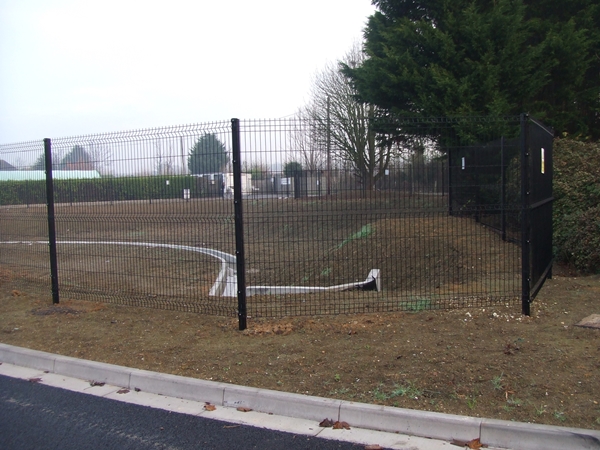
An Anti-Climb Fence installed by Safe Site Facilities of Worthing, West Sussex UK
Fencing is available in a range of materials and styles to suit all tastes and budgets. Before choosing the fencing for your property – be it to secure a garden or simply to mark your perimeter, take a few moments to consider exactly what it is you need from your fencing.
Security
Security must be at the top of the list. Are you looking to create a safe garden environment for your children to play in away from prying eyes, or looking to secure your property against intruders?
The height of a fence often goes hand in hand with security; a low fence such as a picket fence or low wall can be easily scaled, whilst timber fence panels are available in a range of heights with around six feet being the norm. A steel palisade security fencing is by design almost impossible to scale, and can be installed alongside a security gate to provide formidable protection to your home, although the design will not provide much privacy.
Materials
The choice of fencing materials can be split into two main categories; natural or otherwise. If you are looking for a truly natural fence, consider sourcing hazel, chestnut or reed whether as screens or hurdles. More standard wooden fence panels are available in a range of designs and height, and remain a popular choice throughout the UK. If you are thinking of opting for metal fences, there is a wide range of metal fences and railings to choose from including rounded bow top or more traditional styles with a range of attractive finials.
Style
The style of a fence can completely alter the appearance of a property. A white picket fence can help create a picturesque cottage garden feel, whilst treated timber fence panels can add warmth to a rear garden. Colour plays a very important part; both wooden and metal fence panels are readily available in a host of colours to suit your individuality. Whilst a steel palisade fence can add cutting edge industrial design, decorative metal railings can help achieve an old fashioned feel.

A beautiful picket fence adds a certain charm to a house. Image: © Copyright nick macneill and licensed for reuse under this Creative Commons Licence
If you are drawn to wooden fence panels don’t think your options are limited; fence panels are available in a host of styles. Look at both overlaid or weatherboard panels, and take time to research all the designs out there such as tongue and groove, woven or even a chevron design. Perhaps add trellis panels to finish off your fencing, whether straight along on the top or to provide a curved design.
If the style of palisade fencing appeals to you, compare wooden vs. metal. Steel palisade fencing will require less maintenance over time than a wooden alternative, but the finished look of each couldn’t be more different.
And if you still can’t make a decision, why not do your bit for the environment – forget the fence and plant a hedge instead?!
Experts in all forms of security and temporary fencing, Safe Site Facilities have provided safety and protection for many hundreds of private and commercial properties. Their knowledge in the area is unsurpassed.
Filed under Installing A Fence, Security Fencing, Wooden Fence Panels by . 1 Comment. ![]()
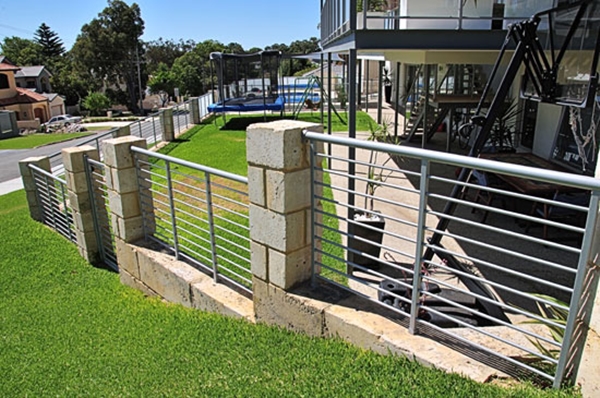
A custom designed Nautical Fence installed by Fencemakers, Australia
Most homeowners who make the decision to install a fence on their property do so for a specific reason. For example, you may have the desire to add security to your property, to keep your kids and pets safely enclosed in your yard, to keep wildlife out of your yard and more. While some fences may be installed purely for safety, security or other functional purposes, some homeowners may want to add a decorative element to their yard with the installation of a fence. While your own needs and desires for the fence may help you to select the right style to install in your yard, there are a few other key points to consider before you call a fencing company for installation.
Building Codes
Many homeowners live inside cities or towns, neighborhoods and other municipalities that do have building codes in place. Codes can vary from municipality to municipality and from neighborhood to neighborhood. However, they may affect the height of the fence, how far the fence must be setback from the road, its placement on utility easements, its color and material and more. For some homeowners, these rules may be fairly lenient. For other homeowners, however, the rules can drastically reduce and limit the fencing options available to you. For this reason, it is best to contact your neighborhood association as well as the municipality where you live to learn more about code restrictions that you must abide by.
Your Neighbor
In most cases, the fence that you build will butt up against a property line that you share with a neighbor. This means that your fence will become a fixture that your neighbor must live with as well. To maintain good relations with your neighbor, it is a smart idea to contact your neighbor about your plans to build the fence. In some cases, your neighbor may be willing to contribute to the price of the fence if it benefits him in some way. Your neighbor may have some suggestions or recommendations that you can take into account, and this can help you to keep the peace with your neighbor.
Your Climate
There are a variety of styles of fences that you can choose to install on your property, and with most styles, you can choose to use different materials for the installation. For example, with styles like privacy or picket fences, you can choose cedar slats, treated press board slats, vinyl and more. Even a chain link fence with a privacy screen may provide you with privacy. Consider the climate that you live in and research which materials may be more durable and resistant to the elements.
Durability and Maintenance
While the climate will affect the durability of the material you choose for your fence, other factors will also play a role. For example, some areas are more prone to wood-destroying insects. Wet climates may be more harsh on metal fences. Even in an ideal climate, however, wood fences may need to be stained and treated periodically. Privacy screening on a chain link fence may become damaged if it is placed too close to shrubbery or damage may be caused by pets and wild animals. By considering the durability and maintenance of the material that you choose, you can minimize the maintenance cost for your fence and enjoy improved aesthetic appeal for a longer period of time.
The Appeal of the Fence
If you live in a rural area and simply want to install an affordable fence to keep wildlife out of your yard, an affordable chain link fence may be ideal. Many homeowners, however, want to install a fence that will look great on their property and that will add style. There are numerous stylistic features that can be added to a privacy fence, and you can discuss those options in detail with a professional fence installation company. Other commonly used styles that boast aesthetic appeal include a picket fence and a split rail wood fence.
Eco-Friendly Options
When selecting the right fence material and style, you may consider eco-friendly options. Eco-friendly options may be those made of recycled materials or materials that can be recycled after use. They may also be biodegradable and require minimal maintenance over time. Bamboo fencing is a smart choice because this type of wood grows quickly to minimize the issue of deforestation. The material also is more weather resistant than other types of wood and may require minimal maintenance and upkeep. You may also consider other materials like wrought iron, aluminum and recycled wood materials as eco-friendly options.
Left: Bamboo Fencing has it’s own charm. Photo Courtesy: Patty Myrick
Your Budget
Your budget for the fence is a factor that you cannot overlook. Fencing prices vary considerably based on factors like the material used, the height of the fence, the spacing of the posts, decorative features added to the fence and more. To save money, you may consider installing a slightly shorter fence or using a combination of materials. For example, if your home backs up to vacant or undeveloped land, you may consider installing a tall privacy fence along the sides of your yard and a chain link fence along the back of the yard. Tall bushes and shrubs can be planted along the rear of your yard if needed for additional privacy or to add decorative appeal to the yard.
A professional fencing company like Fencemakers of Perth, Australia can help you with a variety of designs (above) for your fence and install it within a short period of time.
Many homeowners consider installing their fence on their own, but there are good reasons why you should contact a professional fencing company for installation. First, it can take a considerable amount of time and effort to dig post holes and set posts. It may take you several weeks to do the same job that a fencing company can do within a day or two. Furthermore, you want your fence to look perfect and to have durable construction. Fencing experts can provide you with a variety of options including aluminium fencing which will provide you with a professional look as a finished result, and some may offer a warranty on their work. The company can also assist you in selecting the right materials and style for your yard. You can enjoy the benefits of a fence more fully and easily when you contact a professional for installation of your fence.
Filed under Installing A Fence by . Comment. ![]()
Equine fences for horses built by Three Shires Countryside Management of UK
Every horse owner needs a safe and reliable equine perimeter fence to keep them from running loose, wandering into traffic and/or getting into any other kind of situation to injure themselves. Since keeping horses secure and contained is a constant challenge, it becomes paramount to choose the right equestrian fence. Such a fence plays an important role in good horse management.
While we’ll be discussing the various aspects of fencing for horses on our blog, let’s first take a closer look here at the most important member at the center of an equine fencing system – your beloved horse.
Taking care of your horse properly is extremely important, both in the stable and in the field. It is not only essential that you groom your horse when it’s in the stable but it’s also vital that you take extra steps to ensure their comfort after you’ve been out for a ride.
Here are a few steps that you should follow in order to ensure the best care for your horse:
1. As soon as you get off the horse you should loosen the girth or cinch; this is the piece of equipment that is used to keep the saddle in place.
2. It’s important for your horse to cool down so if you’ve been out for a strenuous ride then you should walk for a while until the horse’s pulse and heart rate return to a more normal state. You can usually be sure that the horse has cooled down if it is no longer puffing.
3. Attach the stirrups to the saddle – this takes a big weight off the horse’s back and makes the recovery process much faster. In order to lift the stirrups, pull the loop at the back of the saddle through the stirrup and attach them.
4. You should only unbridle the horse in a safe place – i.e. wherever you tacked it up.
5. Safely tie the horse up and undo the girth – or cinch – put it up onto the saddle unless it is wet or dirty – then you may wish to take it off completely.
6. Next you should take the horse’s saddle off, but make sure you hit it high enough so that it doesn’t hit the horses back.
7. Next you should take off the horse’s blanket that is placed under the saddle; this can be washed in a household washing machine. You should always make sure the blanket is clean and dry because a dirty blanket can cause chaffing to the horse’s skin.
8. You should always clean the horse’s back to remove any saddle marks. If the weather is warm you could use a damp sponge; if it’s cold then stick to a dry towel to dry and clean away the marks. When the marks have gone, be sure to brush the hair flat in order to prevent it from becoming matted.
9. Even though you always clean the hooves thoroughly before a ride, make sure that you check them after too in order to make sure they haven’t picked up any rocks.
10. Take your horse to its stable and feed it. You should probably wait for about an hour after a ride before feeding.
This article was written by professional rider Stephanie Podmore; for all of your equestrian fencing needs, she recommends www.threeshires.com.
Filed under Equestrian Fencing by . Comment. ![]()
The appearance of a fence may influence one’s opinion about what lies beyond it.
When we think about installing fencing, it is usually because we have a need to contain or protect something on the property.
Surprisingly, a fence may communicate more about the owner or company than they intend and that message goes far beyond the simple statement of “something of value here,”; it can tell whole stories. It’s interesting to examine what impression a fence might convey about the area or property it encloses.
Cultural Differences
In peaceful communities, fences are used to contain livestock or as a line of demarcation and are ‘friendly boundaries’.
Different cultures use fencing in different ways. Some cultures highly prize ownership, property and individuality and the use of a fence – a high, strong unbreakable fence is common and considered a sign of having made a success of oneself. In other cultures where community is king, fences are rare; often only used to try and contain livestock or control soil erosion.
A fenced-in property is usually perceived as having something that is either unacceptable to the community, such as a prison, or something that is beyond the community –such as a palace. While these cultural differences do appear most strongly in their native countries, their influence also lingers when the population immigrates. How far away you have grown from your native culture will be revealed by your attitude towards fences and your choice of whether or not to have one and of what type.
Social Intentions

This ‘baby’ called an Interceptor Gate by Barkers Fencing Australia can drop a 7.5 tonne truck traveling at 50mph (80km/h) like if a Spanish bull hit a thick cement wall! Wanna see how? Watch the video at the end.
The type of fence installed around property or business is also a telling indicator of their attitude toward the surrounding community. For a business, a practical fence meant to secure property and assets is appropriate in any community. If that fence begins to become fortress like, it communicates a distrust of the surrounding community. The same is true for fences around homes.
One does need a sturdy fence for residential areas and a protective gate for a business but a barbed wire fencing in such places under ‘normal’ circumstances would be an overkill.
There are few neighborhoods where a barbed wire tipped fence is considered appropriate. The intentions shown by barbed wire should not be confused with those shown by cast iron spear tipped fences. These are not taken as “security” fences so much as a statement of the wealth and class standing of the individual behind them. They clearly broadcast that the inhabitants consider themselves of a certain level and, most likely, above the community. Stone walls are the salt of the earth type of fence and communicate the exact opposite (unless of a spectacular height). A stone wall is seen as a working man’s fence to try and protect his livelihood. It is the one type of fence that is the most neutral of all for it carries little double message of exclusion or rejection towards those without.
Who cares?
Put the wrong type of fence in the wrong area and send the wrong message and you may be surprised that someone may try to break in. An “offensive fence” can invite more vandalism and criminal intention than a practical fence. Knowing what you are saying, even when it is not a message you intend to send, can help prevent unnecessary trouble.
Make the right choice
Barkers Fencing, a industrial and commercial fencing business, installs fencing for security purposes. The choice of a fence has to take into account both the landscaping and design of the property within, and how it fits into the community puzzle without. It should form a border, but not necessarily a boundary.
All fence images used above – Courtesy: Barkers Fencing of Australia
Filed under Security Fencing by . Comment. ![]()
Photo Courtesy: Patrick Byrne
All societies in the history of mankind have had individuals who, for one reason or the other, have tried to encroach on bring harm in some form upon other law abiding people’s properties. So it has always been imperative to protect your land or business throughout civilized history.
There are many ways of using perimeter security to protect your land or business; it’s up to you to choose the best type to suit your individual wants and needs.
Buried Detection System
The first type of perimeter security is a buried detection system. These have the useful advantage of being out of sight and out of mind, so not only does nobody else have to know they’re there, you also don’t have to worry about them looking unsightly. However they’re always there if you need them. They can follow the shape and contours of irregular boundaries and are not constrained to “line of sight” applications. This makes them ideal for irregular shaped sites.
Fence Systems
The next type of perimeter security that can be used, and is probably the most common way, to protect your land is fence systems. This clearly distinguishes the space between private land and other people’s land/private land. You can choose to have a tall fence system to help prevent any intrusion onto your land, or a smaller fencing system to distinguish between your land and that of anybody else. There are also many type of fencing systems you can use; for example, a prison may use high steel fencing with barbed wire across the top for high security, whereas a small business may use a small wooden fence to protect people from trespassing.
Free Standing Systems
The third type of perimeter security is free standing systems. They are useful over long straight stretches of land as there are just two sensors at each side, with a beam between them that must remain unbroken. If the beam is broken by somebody getting in-between the two sensors, it will raise an alarm letting you know that there is an intruder. The main feature of these types of system is that they provide cost effective security over long straight perimeters.
Fibre Optic Detection System

A fibre optic system that protects against unauthorized removal of expensive solar panels by generating an alarm – Developed by GPS Perimeter Systems.
The fourth type of perimeter security is the fibre optic detection systems. They are cables that can run along any fence, wall, and field to detect movement. They can be useful in quieter areas for walls that are already built and need some extra security. These can be installed on fences, pipelines or even buried and can use either newly installed or existing fibres to provide cost effective protection for long perimeters and pipes.
Centralized Alarms
The final perimeter security to use would be centralized alarms. This system makes use of a number of sensors used to detect movement; if any of the sensors detect movement, they set off a centralized alarm which can only be de-activated through a code or login. When operating and maintaining such a perimeter security system, it is possible to access the sensor data from a central point, without physically going to each individual sensor.
There are clearly a variety of ways to choose to protect your land using perimeter security. Some of them are more subtle and unnoticeable, while others are there to clearly show that you want to protect your belongings. Choosing the right security for you is important to give you piece of mind and to ensure you are able to protect what is yours.
This guest post was written by Paul Longshaw, a supervisor in the security fencing sector.
Filed under Security Fencing by . Comment. ![]()
A sturdy fence is a must for any farm. Above: Farm fence built by Total Equine Fencing
Farm Fencing For A Refreshing New Look
Farmers work hard to make their land look pleasing to the eye. A farm ringed by a rustic fence adds a charm that captures an authentic farm scene. Farm fences are as functional as they are attractive. There are a variety of fence styles that provide security and coordinate well with the structures they surround.
Replace Or Repair – How To Decide
Most farm fences can be easily repaired unless there has been major deterioration or damage from storms or extremes of weather temperatures. Determine whether the fence can be salvaged with a little repair. This is the most economical step to keeping farm fencing fresh looking. If repair is more feasible, determine the length of fencing that needs repair. Repair can be done in increments for corrals, pastures and livestock enclosures.
Keep in mind that the longer a fence remains in disrepair, the more costly repairs may be. This is one reason to maintain farm fencing and make regular inspections of their general condition. This includes inspections of fence posts and related joinings/joints and parts. Once a farm fence shows signs of wear, repair should be done as quickly as possible.
Farm Fencing Repair – Quick And Cost-effective
Thanks to today’s new technologies, farm fence repair is quick and cost-effective. The benefit of technology is a virtually undetectable fence repair that matches woods and metals to the existing fence material perfectly. Decorative farm fencing gets a second life with proper repair and keeps the farm looking neat and refreshed. Repair experts can be found on most social media venues. Look for those with the most experienced in farm fencing repair to ensure top quality. This is also a good way to compare pricing to arrive at a reasonable cost for repairs.
Also check the material composition of the fencing. This may be wood, galvanized steel in bar or chair link, galvanized wire, woven wire, mesh, aluminum or PVC. Each of these is available for functional and decorative fencing to match existing fences. Split rail fencing is a traditional look originally created from wood. Today, split rail fences can be manufactured from poly vinyls as well as from sturdy wood. These are the easiest to repair as they require fewer parts replacements.
Things To Do Before Repair
Once the fence has been fully inspected, there are several things to do before calling a repair expert. Measure the area of fence to be repaired. A faster way to obtain a clearly visual assessment of repair is to use a digital camera or a smart phone to photograph the actual location of repairs needed. This can be downloaded to the repair shop to expedite the order for repair. Before repair begins, discuss labor and installation costs as well as the materials needed to complete repair. Check credentials of the repair company and warranties for service and parts replacement if applicable. Discuss the time involved in completing the repair project. Take before and after photographs to insure satisfaction.
This post was provided by Tiffany Lindsey, a horse show enthusiast and farm owner. She needed fence repair services to update the look of her farm and called Total Equine Fencing. She was more than satisfied with the results.
Filed under Farm Fencing, Fence Repair by . Comment. ![]()
It’s an all too familiar news story: a child wanders into a pool area and drowns with a parent or caregiver just feet away. Someone crosses a neighbor’s yard in the night and slips and falls into the pool, drowning as a result. These types of accidents are especially tragic because of how avoidable pool accidents are with proper safety fencing. If your pool is fenced in, it’s safer for you, your family and everyone else.
Fencing Types
Pool fencing comes in many types. Mesh wire fencing surrounds the pool with mesh wire panels, but some pool owners find mesh fencing inconvenient to use and unattractive. Chain-link and wrought iron fences are economical and sturdy but may not present much visual appeal, giving the pool a “prison” appearance in smaller yards.
Glass fences are attractive to visitors and may make a small yard appear larger. Glass safety fences have become more popular over the last few years because the materials don’t interfere with the yard’s appearance and are often more stylish than traditional mesh or plain iron fences.
Fencing, unlike a swimming pool enclosure, is usually removable. If you live in an area with periods of rough weather, such as snow, you’ll want to use fencing you can easily remove during bad weather so you can protect the fencing from damage.
Proper Installation and Features
All pool safety fences, no matter what the type, must be properly installed with the features and spacing necessary for safety. Children should not be able to climb over, under, through or around the fencing, so the fencing you select should be too tall for a child to climb over and too dense for the child to get through fence post spaces.
Fencing should be sturdy and installed deep enough into the ground so a person can’t pull up a section by applying force. Common fencing gates are either self-latching or have a manual lock or padlock. All persons who will be using your pool should know how to open and close the gate correctly.
Local Regulations
Some areas have laws requiring safety fencing around a pool. If you live in an area with a pool fencing safety regulation and fail to comply, you may face fines and penalties. You may face a lawsuit if a person has an accident in your pool if you didn’t have safety fencing installed.
When you’re looking for safety facing, consider your needs and budget. Have the fencing professional-installed if you’re uncomfortable with doing it yourself.
Fencemakers specialize in pool fencing that will look great and help keep your pool area safe. They also offer a complete range of fences including aluminium fence, gates, steel fencing, security fencing and much more.
Filed under Pool Fence by . 1 Comment. ![]()